We are detectives for property, and we share what we investigate.
The jamabandi is the first record every Bihar land buyer should pull, and the one most buyers misread. It takes five minutes on the Bihar Bhumi portal and costs nothing. This guide shows how to find it, how to read each field, and what a mismatch tells you about the seller. It is part of our guide to avoiding the land mafia when buying land in Bihar.
What the jamabandi is (and is not)
The jamabandi, also called Register II or jamabandi panji, is the revenue department’s ledger of who pays land rent (lagan) on which plots. Each holding has a jamabandi number, and each jamabandi lists the raiyat (holder), the khata and khesra numbers, the area and the rent due.
It is not a title document. It records who the state collects rent from. The Supreme Court said as much in 2025: mutation follows ownership, not the other way around. A clean jamabandi in the seller’s name is a good sign. A missing or mismatched one is a warning. Neither replaces a check of the deeds. Our explainer on what each land paper proves covers the difference.
What you need before you search
| Detail | Where to get it |
|---|---|
| District and circle (anchal) | The seller’s deed, or ask which block office the village falls under |
| Halka and mauza (revenue village) | The seller’s deed or rent receipt. The mauza name can differ from the locality’s common name |
| Khata number | The seller’s deed, khatiyan or rent receipt |
| Khesra (plot) number | The seller’s deed. A plot can span more than one khesra |
| Seller’s name and father’s name | The seller’s ID and deed |
How to check jamabandi online, step by step
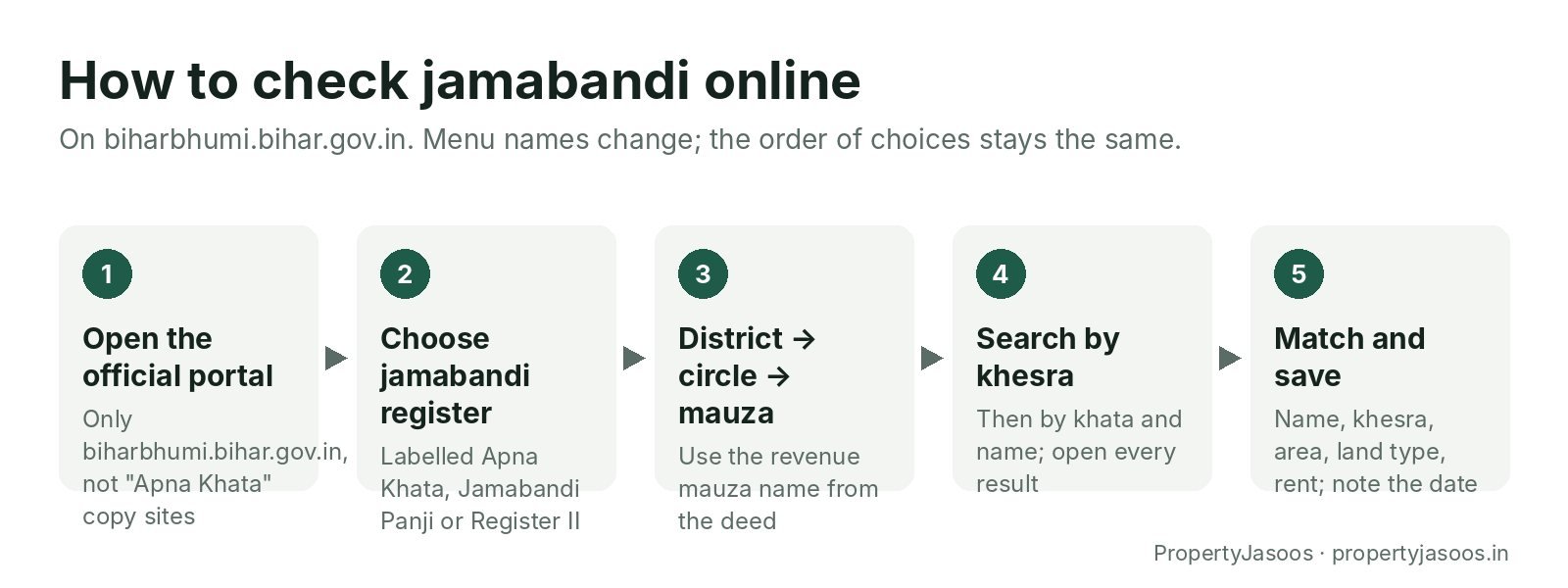
- Open the official portal, biharbhumi.bihar.gov.in. Many “Apna Khata” and “Bihar Bhulekh” sites are private copies with ads and stale data. Use only the .bihar.gov.in address.
- Choose the jamabandi register option. The menu label has changed over the years (“Apna Khata”, “Jamabandi Panji Dekhen”, “Register II”), but it is the link for viewing the jamabandi or land record.
- Select district, then circle, then halka and mauza. If the mauza is not listed, check the spelling in Hindi and try nearby names. Some villages are listed under an older revenue name.
- Search by khata, khesra, jamabandi number or raiyat name. Search by khesra first. A name search often misses entries because of spelling differences.
- Open every result for that khesra, not just the first. More than one jamabandi on the same khesra means the plot has been split, sold in parts or is disputed.
- Save or print the page and note the date you checked it. You will check again on the day of the registry.
How to read the jamabandi page
| Field | What to check | Red flag |
|---|---|---|
| Raiyat name and father’s name | Matches the seller’s ID and deed exactly | A different person, or a dead ancestor |
| Khata and khesra | Matches the deed and the plot you were shown | The khesra on the deed is missing here |
| Area (rakba) | Equal to or more than what is being sold | The seller is selling more than the jamabandi shows |
| Land type | Raiyati (private) land | Gair-mazarua, Bhoodan, kaiser-e-hind or similar government categories. See government land types to avoid |
| Rent paid up to | Recent year | Many unpaid years, or receipts the seller shows that do not appear here |
| Status or remarks | Active, with no remarks | Locked, blocked, cancelled or “under correction” |
What a mismatch usually means
- The jamabandi is in a grandfather’s name. Inheritance was never mutated. Every legal heir has a share, including daughters. Read buying ancestral land in Bihar before you go further.
- The jamabandi is in someone else’s name. Either the seller bought it and never got the mutation done, or the seller does not own it. Ask for the seller’s registered deed and check its chain.
- Two jamabandis on one khesra. The plot was split, or two people claim it. Find out which part each covers before you pay anything.
- The jamabandi was created recently. Check the mutation case behind it. A new entry made on a forged deed is a known fraud pattern; in February 2026 Patna’s district administration registered an FIR over exactly such a mutation in the Phulwari Sharif circle, as reported by Patna Press.
- The entry is locked or under correction. There is a pending dispute, correction or government objection. Ask the circle office why.
Other checks on the same portal
- Mutation status: look for any pending dakhil-kharij case on the khesra. A pending case in a third person’s name means someone else has already bought, or claims to have bought, the plot. Our mutation guide explains the process.
- Rent (lagan) record: compare the seller’s paper rent receipts with the online record. Receipts that do not appear online may be backdated.
- Correction (Parimarjan): if the record has an error, the holder applies for correction through the Parimarjan service. A seller who is “getting the record corrected” should finish that before you pay the advance.
- Map: pull the khesra on Bhu-Naksha (bhunaksha.bihar.gov.in) to see its shape and neighbours.
The PropertyJasoos land-safety series
- How to avoid the land mafia when buying land in Bihar (the full guide)
- What each Bihar land paper proves
- How to check if land has already been sold
- Buying ancestral land in Bihar safely
- Buying land through a power of attorney
- Mutation (dakhil-kharij) after you buy land
- Government land types to avoid in Bihar
- Where to complain about land fraud in Bihar
FAQ
Is an online jamabandi printout valid as a legal document?
The online view is good for checking. For a loan or a court case, banks and courts may still ask for a certified copy. Ask your bank or lawyer which version they accept.
The seller’s name is not in the jamabandi. Can the deed still be registered?
Yes. Since the Supreme Court’s November 2025 ruling in Samiullah v. State of Bihar, a sub-registrar cannot refuse registration for that reason. That makes your own check more important, not less.
Can I search jamabandi by owner name only?
Yes, but name searches often miss entries because of spelling and transliteration. Search by khesra and khata as well.
How often should I check?
Before the token, before the advance, on the morning of the registry, and a few times a year after you buy, so you see quickly if anyone tries to change the record.
Portal menus change often. If a step here no longer matches the site, tell us and we will update this guide. This is general information, not legal advice.


